
Benefits of Hiring a Professional GST Consultant in Bhavnagar
Running a business involves much more than managing daily operations and serving customers. Every business owner must also ensure timely tax compliance, accurate record-keeping, and adherence to government regulations. Among these responsibilities, Goods and Services Tax (GST) compliance is one of the most important. Whether you’re a startup, manufacturer, trader, retailer, exporter, or service provider, managing GST without professional guidance can lead to costly mistakes. This is why hiring a Professional GST Consultant in Bhavnagar can be one of the smartest decisions for your business. At Rudra Consultancy, we understand the challenges businesses face while managing GST registration, return filing, Input Tax Credit (ITC), GST notices, audits, and ongoing compliance. Our experienced team, led by CA Pratik Bhatt, has been helping businesses across Bhavnagar simplify GST compliance with reliable, transparent, and professional tax solutions. In this guide, we’ll explain the key benefits of hiring a professional GST consultant, how expert GST services support business growth, and why businesses across Bhavnagar trust Rudra Consultancy for their GST compliance needs. Understanding the Importance of GST Compliance Goods and Services Tax (GST) has transformed India’s indirect taxation system by replacing multiple taxes with a unified structure. While GST has simplified taxation in many ways, businesses still need to comply with several legal requirements, including: GST Registration GST Return Filing Invoice Management Input Tax Credit (ITC) Reconciliation GST Audit GST Notice Handling E-Way Bill Compliance E-Invoice Compliance Annual GST Returns Missing a deadline or making a small filing error can result in penalties, blocked ITC, interest charges, or departmental notices. A professional GST consultant helps ensure every compliance requirement is completed accurately and on time. Why Businesses in Bhavnagar Need Professional GST Services Bhavnagar has become an important commercial hub in Gujarat with businesses operating across manufacturing, trading, retail, exports, logistics, healthcare, construction, textiles, ship recycling, and service industries. As businesses continue to grow, GST compliance also becomes more complex. Every industry has different GST implications. Manufacturers deal with Input Tax Credit and inventory management, traders manage purchase and sales reconciliation, exporters handle GST refunds, while service providers focus on accurate tax calculation and timely return filing. Professional GST consultants understand these industry-specific requirements and provide solutions tailored to each business. Top Benefits of Hiring a Professional GST Consultant in Bhavnagar 1. Hassle-Free GST Registration GST registration is the first step toward legal tax compliance. While the online registration process appears simple, many applications face delays due to incorrect documentation or incomplete information. A professional GST consultant helps you: Complete the registration process accurately Verify all required documents Avoid unnecessary application rejections Obtain GST registration quickly Whether you’re starting a new business or expanding your operations, professional assistance makes the registration process smooth and stress-free. 2. Accurate GST Return Filing GST return filing is a recurring responsibility for every registered business. Missing deadlines or filing incorrect returns may result in penalties and compliance issues. Professional GST consultants ensure: Timely filing of GSTR-1 Accurate GSTR-3B filing Annual GSTR-9 filing Proper reconciliation before submission Error-free GST returns This reduces compliance risks and helps businesses maintain a clean GST record. 3. Better Input Tax Credit (ITC) Management Input Tax Credit (ITC) directly impacts business profitability. Incorrect reconciliation often leads to: Loss of eligible tax credit ITC mismatches Departmental queries Financial losses Professional GST consultants regularly reconcile purchase records with GSTR-2B to ensure businesses claim every eligible Input Tax Credit while remaining compliant with GST regulations. 4. Avoid Costly Penalties Many businesses pay unnecessary penalties simply because of: Late return filing Incorrect GST calculations Wrong HSN/SAC codes Missed compliance deadlines Hiring a professional GST consultant significantly reduces these risks by ensuring all compliance requirements are completed accurately and within the prescribed timelines. 5. Expert Assistance with GST Notices Receiving a GST notice can be stressful for any business owner. Common reasons include: Return mismatches Incorrect ITC claims Delayed filings Documentation issues Audit observations Instead of responding without professional guidance, businesses should seek assistance from experienced GST consultants who understand departmental procedures and can prepare accurate responses. 6. GST Audit Support GST audits require proper documentation, transaction verification, reconciliation, and compliance review. Professional consultants help businesses: Prepare audit-ready records Verify GST returns Reconcile financial statements Identify compliance gaps Reduce audit risks Proper preparation saves valuable time during departmental audits. 7. Saves Valuable Business Time Business owners should focus on managing customers, employees, and business growth—not spending hours understanding GST regulations. Outsourcing GST compliance allows entrepreneurs to: Save time Reduce administrative work Improve productivity Focus on business expansion 8. Professional Tax Advice GST laws continue to evolve with regular notifications and amendments. Professional consultants stay updated with: GST Council decisions Latest compliance requirements New filing procedures Government notifications This ensures businesses always receive current and reliable tax advice. 9. Industry-Specific GST Solutions Every industry has unique GST requirements. Professional consultants understand GST implications for: Manufacturing Businesses Traders Retail Stores Exporters Construction Companies Healthcare Businesses Restaurants IT Companies E-commerce Sellers Service Providers Customized GST solutions improve compliance while reducing operational challenges. 10. Better Financial Planning Accurate GST compliance improves financial planning by: Maintaining proper cash flow Maximizing ITC Reducing penalties Improving tax forecasting Supporting better budgeting Professional GST guidance contributes to long-term business stability. Who Should Hire a GST Consultant? Professional GST services benefit businesses of every size, including: Manufacturers Managing GST on production, purchases, inventory, and sales requires accurate compliance. Traders & Wholesalers GST consultants ensure smooth purchase reconciliation and return filing. Retail Businesses Retailers benefit from proper GST billing, filing, and compliance support. Startups New businesses receive guidance from registration to ongoing compliance. Exporters Professional consultants assist with export documentation and GST refund claims. Service Providers Service businesses receive support for GST calculation, invoicing, and return filing. MSMEs Small and medium businesses benefit from affordable, professional GST compliance solutions. Why Businesses Choose Rudra Consultancy Businesses across Bhavnagar trust Rudra Consultancy because we focus on accuracy, transparency, and long-term client relationships. Our services include: GST Registration GST Return Filing GST Audit Support Input Tax Credit Reconciliation GST Notice Handling
Why Hiring a Chartered Accountant in Bhavnagar Saves You Time and Money
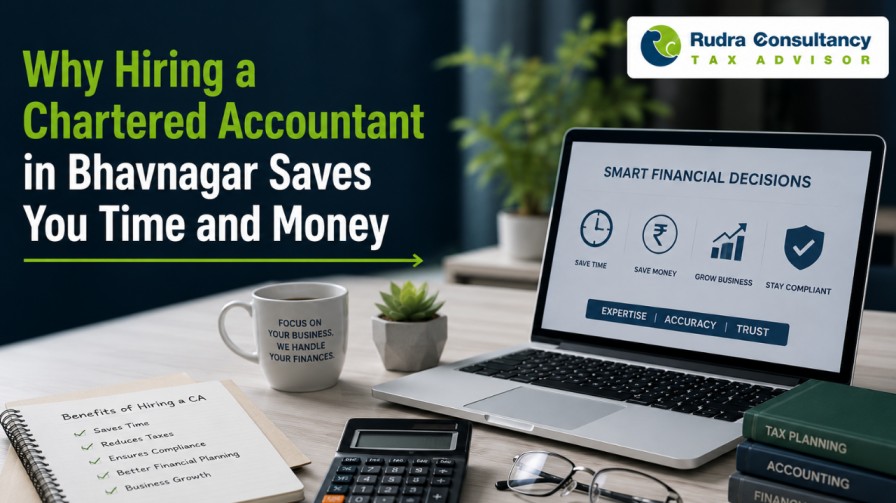
Running a business in Bhavnagar is exciting – but let’s be honest, managing taxes, GST filings, and financial records can quickly become overwhelming. Between serving your customers and growing your business, who has time to keep up with changing tax laws and compliance deadlines? That’s exactly where a professional Chartered Accountant in Bhavnagar makes a real difference. Whether you own a small shop near Ghogha Circle, run a manufacturing unit, or manage a trading business, having the right CA by your side can save you a significant amount of time, money, and stress. In this blog, we’ll walk you through the real, practical benefits of hiring a CA firm in Bhavnagar – and why it’s one of the smartest financial decisions you can make for your business. 1. You Stop Wasting Time on Paperwork and Compliance Time is your most valuable asset as a business owner. Yet most small and medium business owners in Bhavnagar spend hours every month on tasks like: Preparing GST returns and reconciling records Tracking income and expenses manually Filing income tax returns (ITR) Managing TDS deductions and payments Responding to tax department notices All of this takes time away from what you actually do best – running your business. When you hire a Chartered Accountant in Bhavnagar, all of these tasks are handled professionally. Your CA takes care of deadlines, filings, and compliance – so you don’t have to worry about missing a due date or making a costly mistake. At Rudra Consultancy, our team manages your complete financial calendar – from monthly GST returns to annual income tax filings – so you can focus 100% on your business growth. 2. A CA Helps You Pay the Right Amount of Tax – Not More, Not Less One of the biggest myths among business owners is that paying more tax means you’re doing better. In reality, many businesses in Bhavnagar pay more tax than they legally need to — simply because they don’t know about the deductions and exemptions available to them. A qualified CA understands Indian tax laws in depth. They help you: Claim all eligible business deductions (rent, equipment, salaries, travel, etc.) Choose the right tax regime (old vs. new) for maximum savings Plan depreciation on assets correctly Avoid penalties from incorrect tax calculations Optimize your GST input tax credit This is called tax planning – and it’s completely legal. It’s not about avoiding taxes; it’s about making smart decisions so your hard-earned money stays in your pocket. Businesses in Bhavnagar – whether in ship recycling, textiles, agriculture, or retail – have different tax structures. Rudra Consultancy provides customized tax planning strategies tailored to your specific industry and income profile. 3. GST Compliance Becomes Hassle-Free Since GST was introduced, it has become one of the most complex parts of running a business in India. GST rates, return filing deadlines, input tax credit rules, e-way bills – it’s a lot to track on your own. Missing even one GST return can attract interest, penalties, and even suspension of your GST registration. That’s a serious risk for any business in Bhavnagar. A Chartered Accountant who specializes in GST will: File your GSTR-1, GSTR-3B, and annual returns on time Reconcile your purchase and sales data monthly Maximize your input tax credit (ITC) Handle GST notices and department queries Advise on GST classification for your products or services Rudra Consultancy‘s team of GST consultants in Bhavnagar handles the full GST lifecycle for businesses – from registration to monthly compliance to refund claims. 4. Proper Bookkeeping Gives You a Clear Picture of Your Business Do you actually know how profitable your business is right now? Many business owners in Bhavnagar run on gut feeling – which works until it doesn’t. Proper bookkeeping and accounting gives you: Real-time visibility into your income and expenses Accurate profit and loss statements Cash flow tracking so you’re never caught short Financial reports that banks and investors trust A clean audit trail if the tax department ever inquires A good CA firm in Bhavnagar doesn’t just file your taxes – they help you understand your numbers. When you understand your numbers, you make better business decisions. Rudra Consultancy offers bookkeeping services on Tally, QuickBooks, Xero, and Zoho – so we can work with whatever system your business already uses. 5. You’re Protected During Audits and Tax Notices Receiving an Income Tax notice or a GST audit letter is stressful – especially if you’re not prepared. The good news? When you work with a CA, you’re never facing these situations alone. A qualified Chartered Accountant in Bhavnagar will: Represent you before the Income Tax Department Draft and submit replies to notices on your behalf Conduct internal audits to catch issues before authorities do Maintain proper documentation so your books are always audit-ready Help you respond to GST department inquiries without panic Many business owners in Bhavnagar have avoided heavy penalties simply because their CA had everything properly documented. That peace of mind is priceless. 6. Business Registration and Startup Compliance Made Easy Starting a new business in Bhavnagar? The list of things to do can feel endless: Choose the right business structure (Sole Proprietorship, Partnership, LLP, Pvt Ltd) Register for GST Apply for MSME / Udyam registration Open a current account Get professional tax registration Set up payroll if you have employees A CA firm in Bhavnagar can guide you through all of this smoothly, so your business starts on the right legal and financial footing from Day 1. Rudra Consultancy helps new businesses in Bhavnagar get started quickly – handling all registrations and compliances so entrepreneurs can focus on building their dream, not dealing with government paperwork. 7. Long-Term Financial Planning for Your Business Growth A good Chartered Accountant doesn’t just look backward at last year’s numbers. They help you plan for the future. Whether you’re planning to expand your business, take a business loan, bring in a new partner, or eventually exit the business – your
ITR Filing Mistakes That Lead to Tax Notices – And How to Fix Them
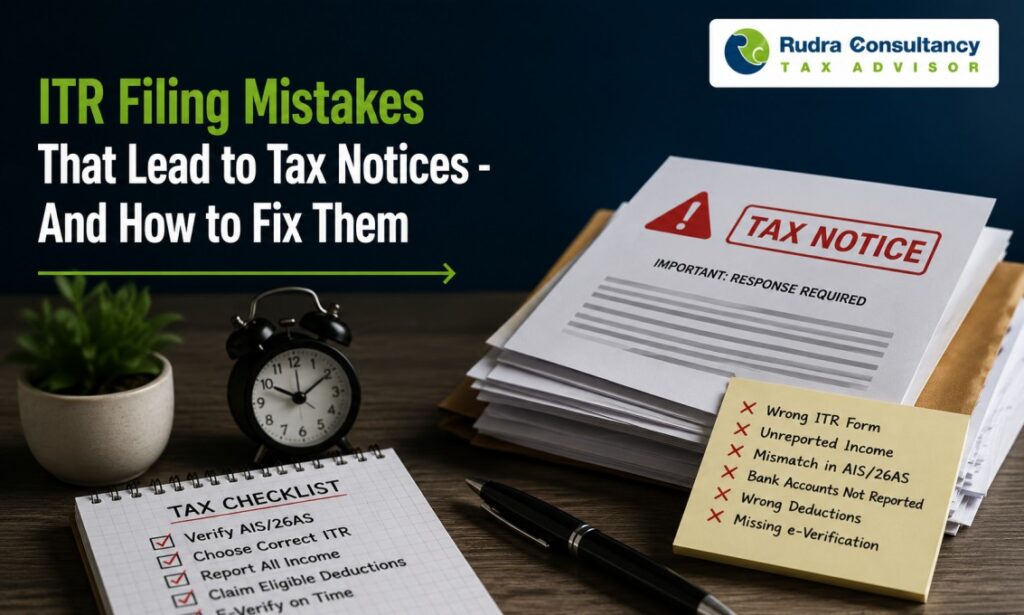
Getting a notice from the Income Tax Department is one of the most stressful experiences for any taxpayer. Your phone buzzes, you see an email from the Income Tax Department, and suddenly your mind goes to the worst possible outcome. The truth is, most income tax notices in India are not about fraud or evasion. They are triggered by simple, avoidable mistakes made during ITR filing – mistakes that thousands of taxpayers in Ahmedabad make every single year. In this guide, CA Pratik Bhatt from Rudra Consultancy walks you through the most common ITR filing mistakes that lead to tax notices, why they happen, and exactly what you need to do to fix them or avoid them altogether. Why Does the Income Tax Department Send Notices? Before diving into the mistakes, it helps to understand how the department spots them. The Income Tax Department’s systems automatically compare your filed return against data collected from multiple sources – your employer, banks, mutual fund houses, property registrars, and stock brokers. This data is available in your Annual Information Statement (AIS) and Form 26AS. When what you report in your ITR does not match what the department already knows about your income, the system flags it. That flag often turns into a notice under Section 143(1), 139(9), 148, or 156, depending on the nature of the mismatch. The good news is that if you know what triggers these flags, you can avoid them entirely. Mistake 1: Not Reconciling Form 26AS and AIS Before Filing This is the single biggest cause of tax notices in India, and it is completely avoidable. Form 26AS and the Annual Information Statement (AIS) are the department’s version of your financial story for the year. They include every rupee of TDS deducted on your income, every significant transaction reported by banks and financial institutions, and every source of income linked to your PAN. The department compares these records against your filed return automatically. If you report income or TDS figures that do not match what is already in Form 26AS or AIS, you will receive a notice under Section 143(1) asking you to explain the discrepancy. This happens even when the difference is a minor rounding error. How to fix it: Before you file – or before you hand your documents to a CA – log in to the income tax portal, download your Form 26AS and AIS, and go through them carefully. Match every TDS credit shown there against your Form 16, bank statements, and investment records. If you notice an error in Form 26AS – for example, your employer has deposited TDS but it has not yet reflected – get it corrected before filing, not after. Mistake 2: Choosing the Wrong ITR Form Selecting the incorrect ITR form is more common than most people think, and it results in your return being treated as defective under Section 139(9). A defective return means you receive a notice asking you to re-file the correct form within 15 days, failing which your original filing is treated as invalid. The most common version of this mistake is salaried individuals filing ITR-1 when they have sold shares, mutual funds, or property during the year. ITR-1 is only for salaried income up to ₹50 lakh with one house property. The moment you have capital gains – even a small mutual fund redemption – you need to file ITR-2 instead. Similarly, a freelancer or consultant who maintains books of accounts should be on ITR-3, not ITR-4. Someone opting for presumptive taxation under Section 44AD or 44ADA uses ITR-4, but only if they meet the specific conditions for that scheme. How to fix it: Map your income sources for the year before selecting your form. If you have even one source of income beyond salary and interest – a property sale, a mutual fund redemption, a second house – go through the form selection criteria carefully or ask a CA to confirm which form applies to you before filing. Mistake 3: Not Reporting All Bank Accounts Every bank account you hold – savings, current, or otherwise – must be disclosed in your ITR. This is not just about the account where you want your refund credited. All accounts where you held money during the financial year need to be listed. Many taxpayers forget dormant accounts, old accounts they barely use, or a second savings account they opened years ago. The department’s system links all accounts to your PAN, so any account that is not disclosed in your return while it shows activity in your AIS is an automatic red flag. How to fix it: Before filing, make a list of every bank account linked to your PAN. You can check this on the income tax portal under your profile. Report all of them in the ITR, even if they had zero transactions during the year. Designate one as the primary account for refund credit. Mistake 4: Missing Interest Income – Savings, FD, and RD This one catches a surprising number of people who consider themselves careful with their taxes. If you have a savings account, a fixed deposit, or a recurring deposit, the interest earned on these is taxable income. It must be declared under the heading “Income from Other Sources.” Banks deduct TDS on FD interest above ₹40,000 per year (₹50,000 for senior citizens), but that TDS deduction appears in Form 26AS. If you do not report the corresponding interest income in your return while the TDS is sitting in Form 26AS, the department’s system immediately spots the mismatch. Savings account interest is also taxable, even though no TDS is deducted on it. The AIS now tracks this from bank reports, so the department knows about it even if you do not report it. How to fix it: Collect interest certificates from all your banks for the financial year. Add up the total interest income from savings accounts, FDs, and RDs, and report it under Income from Other Sources. You can then claim
How to File ITR Online for AY 2026-27: Step-by-Step Guide for Ahmedabad Taxpayers
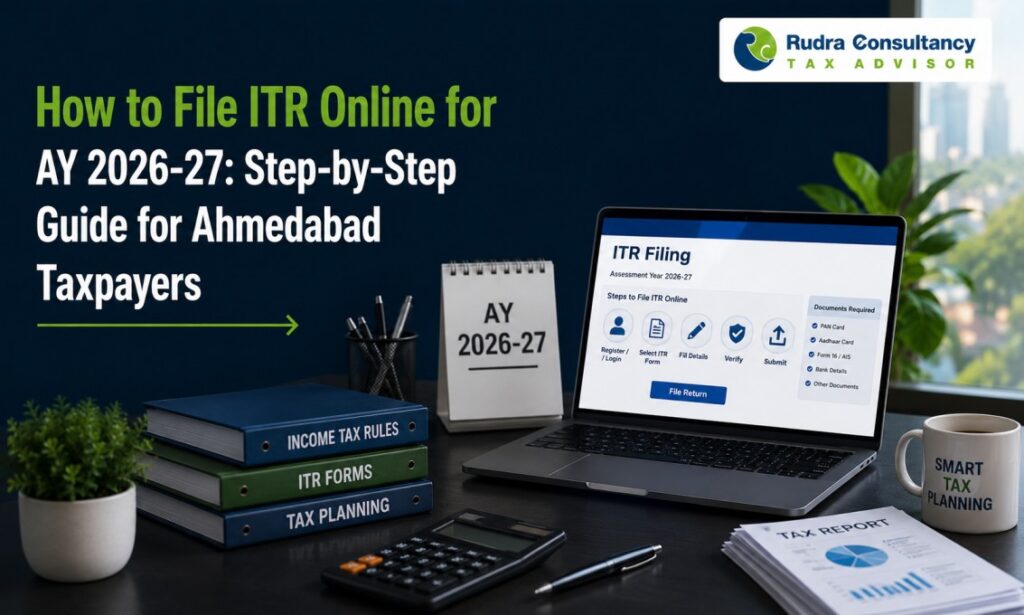
How to File ITR Online for AY 2026-27: Step-by-Step Guide for Ahmedabad Taxpayers This ITR filing guide AY 2026-27 is for the lakhs of taxpayers across Ahmedabad who sit down in late July, open the income tax portal, and realise they’re not sure which form to pick, what’s changed since last year, or whether they should stick with the old tax regime or move to the new one. If that sounds familiar, you’re in the right place.” This guide walks you through everything you need to know to file your Income Tax Return for FY 2025-26 (Assessment Year 2026-27) – from the latest rule changes and revised due dates to a complete step-by-step filing process, document checklist, and the mistakes that most commonly cause refund delays or tax notices. What is an ITR and why it matters An Income Tax Return (ITR) is a form you submit to the Income Tax Department reporting your total income, the tax you’ve already paid (through TDS, advance tax, or self-assessment tax), and your final tax liability for the financial year. Based on this, you either receive a refund for excess tax paid or pay the balance due. Filing your ITR isn’t just a compliance formality. It plays a direct role in: Claiming refunds when excess TDS has been deducted by your employer or bank Getting approved for home loans, car loans, or business loans, where lenders typically ask for 2-3 years of ITRs Visa applications, where ITRs serve as proof of financial stability Carrying forward losses from capital gains, business, or property to set off against future income Avoiding late fees, interest charges, and notices from the Income Tax Department Even if your income is below the taxable limit, filing a return voluntarily can work in your favour, especially if you’re planning a major purchase or application that requires income proof. What’s new for AY 2026-27 This year brings some of the most significant procedural changes in recent memory. Here’s a quick summary of what’s different compared to last year’s filing season. 1. Tax slabs under the new regime have changed The new tax regime continues as the default option, but the basic exemption limit has been raised to ₹4 lakh, and the slab structure now has seven tax brackets ranging from nil to 30% (applicable above ₹24 lakh). If you want to stay with the old regime instead, you’ll need to actively opt for it while filing. 2. Capital gains taxation has been simplified further Short-term capital gains on equity (under Section 111A) are taxed at 20%, and long-term capital gains (under Section 112A) at a flat 12.5%, with indexation benefits removed for most assets. The Cost Inflation Index for FY 2025-26 has been set at 363, relevant mainly for pre-July 2024 property transactions. The earlier date-based split (pre and post 23 July 2024) that caused confusion last year has now been removed from the ITR forms entirely. 3. Filing deadlines are now form-specific Instead of one common deadline for everyone, due dates now depend on which ITR form you’re using. We’ve covered this in detail in the next section, but the short version is: salaried individuals filing ITR-1 or ITR-2 get more time on one end, while business and professional taxpayers filing ITR-3 or ITR-4 (non-audit) now have until the end of August. 4. ITR-U window extended significantly If you’ve missed filing or made an error in a past return, the window to file an updated return (ITR-U) has been extended to 48 months (4 years) from the end of the relevant assessment year, giving taxpayers considerably more breathing room to correct past filings. 5. Additional disclosure requirements New reporting fields have been added for political donations claimed under Section 80GGC, and NRIs opting for presumptive taxation now have a separate reporting schedule. Crypto and other virtual digital assets continue to be taxed at a flat 30%, with no deductions allowed except the cost of acquisition, and losses cannot be set off against any other income. ITR filing deadlines for FY 2025-26 (AY 2026-27) This is one of the most important changes this year, so pay close attention to which category you fall under. Taxpayer category Applicable form Due date Salaried individuals, pensioners ITR-1, ITR-2 31st July 2026 Business/professional income, non-audit cases ITR-3, ITR-4 31st August 2026 Businesses requiring tax audit ITR-3, ITR-5, ITR-6 31st October 2026 Transfer pricing cases Applicable forms 30th November 2026 Belated return (with late fee) Any applicable form 31st December 2026 Revised return window Any applicable form 31st March 2027 Don’t wait until the last week Filing late attracts a penalty of ₹5,000 under Section 234F (₹1,000 if your total income is ₹5 lakh or below), plus 1% monthly interest on unpaid tax under Section 234A. More importantly, if you file a belated return, you lose the option to choose the old tax regime — you’ll be taxed under the new regime by default, regardless of which one is more beneficial for you. Filing on time also means your refund, if any, gets processed faster. Who needs to file an ITR in Ahmedabad? Filing an ITR is mandatory for the following categories, regardless of where you live in Ahmedabad — whether you’re in Bodakdev, Satellite, Vastrapur, SG Highway, or anywhere else in the city: Salaried individuals whose total income exceeds the basic exemption limit before deductions Self-employed professionals, consultants, and freelancers, irrespective of income level Business owners — proprietors, partnership firms, LLPs, and companies Anyone with capital gains from shares, mutual funds, or property sales during the year Landlords earning rental income from one or more properties NRIs with India-sourced income such as rent, interest, capital gains, or business income Anyone who wants to claim a TDS refund, apply for a loan, or needs ITR as income proof for a visa application Individuals who deposited large sums in current accounts, spent significant amounts on foreign travel, or paid high electricity bills, as these trigger mandatory filing under specified conditions even if income is below the
Received a GST Notice? Here Is Exactly What to Do — A Complete Guide for Ahmedabad Businesses
Getting a GST notice in your inbox or mailbox can feel alarming – especially when you are not sure what it means or how serious it is. The good news is that most GST notices can be resolved smoothly if you act quickly, respond correctly, and have the right professional on your side. This guide explains every type of GST notice, what triggers them, and exactly what steps to take. Why GST Notices Are More Common Than You Think Since GST was introduced in India in 2017, the tax department has significantly improved its data-matching technology. Today, the GST system automatically cross-checks your filed returns against your suppliers’ returns, your e-way bill data, your e-invoice records, and even your income tax filings. Any mismatch — no matter how small — can trigger an automated notice. For businesses in Ahmedabad and across Gujarat, receiving a GST notice has become increasingly common. This does not always mean you have done something wrong. Often, it simply means the system has spotted a difference that needs an explanation. But ignoring a GST notice – even a minor one – is never the right move. Important: Every GST notice comes with a deadline. Missing that deadline — even by one day — can result in an ex-parte order, meaning the department passes a decision entirely against you without hearing your side. Always read the notice and act before the due date. Types of GST Notices You May Receive Not all GST notices are equally serious. Understanding the type of notice you have received is the first step toward responding correctly. Here are the most common GST notices that Ahmedabad businesses face: HIGH URGENCY Section 73 / 74 Demand Notice Issued when the department believes tax has been short-paid, unpaid, or ITC wrongly claimed. Section 74 involves alleged fraud or wilful misstatement and carries higher penalties. HIGH URGENCY DRC-01 Show Cause Notice A formal show cause notice demanding explanation before a tax demand is confirmed. This is a critical notice that requires a detailed, legally sound reply within the stipulated time. MEDIUM URGENCY GSTR-2A / 2B Mismatch Notice Issued when ITC claimed in GSTR-3B does not match the data reflected in your GSTR-2B. Very common due to supplier filing delays or errors in purchase data. MEDIUM URGENCY Scrutiny Notice (Section 61) The GST officer has noticed discrepancies in your filed returns and wants clarification. This is a softer notice but still needs a proper, timely response. MEDIUM URGENCY Non-filing / Late Filing Notice Issued when returns have not been filed for one or more tax periods. Along with the notice, late fees and interest will have accumulated and must be cleared. INFORMATIONAL Registration Cancellation Notice If returns are not filed for six or more consecutive months, the department may initiate cancellation of your GST registration. Revocation is possible but requires prompt action. What Triggers a GST Notice? Common Reasons Understanding why you received a notice helps you respond accurately and also fix the underlying issue to avoid future notices. These are the most frequent triggers for GST notices in India: 1. ITC mismatch between GSTR-3B and GSTR-2B This is the single most common reason for GST notices today. If the ITC you claimed in your GSTR-3B is higher than what appears in your auto-populated GSTR-2B — because your supplier filed late, made errors, or did not file at all — the system flags it automatically. The department then issues a notice asking you to either reverse the excess ITC or provide proof that it was legitimately claimed. 2. Difference between GSTR-1 and GSTR-3B figures Your GSTR-1 (outward supplies) and GSTR-3B (summary return with tax payment) must reconcile. If the tax liability shown in GSTR-3B is lower than what GSTR-1 suggests, this discrepancy raises a red flag and can result in a GST scrutiny notice. 3. High ITC claims relative to turnover If your ITC claims appear disproportionately high compared to your declared turnover, it may trigger automated scrutiny. This is especially common in businesses that deal with capital goods, construction, or have recently changed their business mix. 4. Non-filing or irregular filing of returns Missing GSTR-1 or GSTR-3B deadlines repeatedly puts your business on the department’s radar. Even a single unfiled period in a financial year can trigger a compliance notice or initiate proceedings for GST registration cancellation. 5. E-way bill data mismatch The GST department cross-checks e-way bill data with invoices declared in GSTR-1. If goods are moving under e-way bills but the corresponding invoices are missing from returns — or the values do not match — a notice can follow. 6. Income tax and GST data discrepancy The department now shares data between GST and income tax systems. If your declared turnover in your GST returns is significantly different from what appears in your Income Tax Return (ITR), it can result in notices from either or both departments. 7. Fake invoice or bogus ITC suspicion If any of your suppliers are flagged by the department for issuing fake invoices, your ITC claims from those suppliers will come under scrutiny even if you had no knowledge of the fraud. This is a serious situation that requires immediate professional intervention. Note: Many notices are system-generated and are part of routine compliance verification — not investigations. However, the response still needs to be accurate, documented, and submitted on time. Never treat any GST notice as unimportant. Step-by-Step: How to Respond to a GST Notice Whether your notice is routine or serious, the response process follows a clear structure. Here is what a professionally managed GST notice reply process looks like: Read and understand the notice fully Identify the section under which it is issued (e.g. Section 61, 73, 74), the tax period it covers, the specific discrepancy or demand mentioned, and most importantly — the response deadline. Note it immediately. Do not panic — and do not ignore it Many notices are resolved with a simple explanation or document submission. The worst thing you can do is ignore it. Contact a qualified GST consultant in
GST Consultant in Ahmedabad: Everything Your Business Needs to Know About GST Compliance
Running a business in Ahmedabad? GST compliance is not optional and getting it wrong can cost you far more than any professional fee. This guide breaks down everything you need to know about GST registration, return filing, ITC claims, audits, and notices and how a qualified GST consultant can protect your business and keep you penalty-free. Why GST Compliance Is Non-Negotiable for Ahmedabad Businesses Goods and Services Tax (GST) came into effect in India in July 2017 and completely changed how businesses handle indirect taxation. For businesses in Ahmedabad and across Gujarat, staying GST-compliant is not just a legal requirement; it directly affects your cash flow, Input Tax Credit (ITC), vendor relationships, and business reputation. GST laws are updated regularly by the GST Council, meaning what was correct filing practice six months ago may no longer apply today. From changes in GSTR-1 frequency to new rules around e-invoicing and e-way bill compliance, the regulatory environment is constantly evolving. This is precisely why having a trusted GST consultant in Ahmedabad makes a real difference. Did you know? Businesses with annual turnover above ₹5 crore are required to file GSTR-1 monthly. Below that threshold, quarterly filing under the QRMP scheme is available but both require accurate data, timely submission, and proper ITC reconciliation. What Does a GST Consultant Actually Do? Many business owners think a GST consultant simply files returns. In reality, a qualified GST professional covers the entire compliance lifecycle of your business from the day you register under GST to handling departmental audits or notices years later. Here is what a professional GST advisory service in Ahmedabad typically handles: 1. GST Registration – New, Amendment & Cancellation Whether you are a startup, an established trader, a manufacturer, or a service provider, your first interaction with GST is registration. A GST consultant handles the complete registration process from document collection to ARN generation and ensures your business category, HSN/SAC codes, and place of supply are correctly mapped from day one. Common registration services include: New GST registration for individuals, partnerships, LLPs, and private limited companies Amendment of GST registration details (address, trade name, authorized signatory) Addition of new place of business or additional state registration Voluntary GST registration for businesses below the threshold limit GST cancellation or revocation of cancelled registration 2. GST Return Filing – GSTR-1, GSTR-3B, and GSTR-9 GST return filing is an ongoing monthly or quarterly obligation. Missing deadlines or filing incorrect returns invites late fees, interest liability, and in some cases, departmental scrutiny. A professional GST filing service in Ahmedabad ensures your outward supply details, tax liability, and ITC claims are all accurately reported. Key GST returns that businesses need to file include: GSTR-1: Details of all outward supplies (sales) made during the tax period GSTR-3B: Monthly summary return covering tax liability and ITC claim GSTR-9: Annual GST return reconciling all monthly/quarterly data GSTR-9C: Reconciliation statement (GST audit) for businesses above ₹5 crore turnover GSTR-4: Annual return for composition scheme taxpayers 3. ITC Reconciliation and Optimisation Input Tax Credit is one of the most valuable benefits of the GST system – but it comes with strict conditions. Your ITC claim must match with what your suppliers have declared in GSTR-1. Mismatches lead to notices and blocked credits. A skilled GST advisor in Ahmedabad regularly reconciles your purchase register with GSTR-2B data so you never lose eligible ITC. 4. GST Audit and Annual Return Support The annual return and audit process (GSTR-9 and GSTR-9C) requires careful reconciliation of all transactions over the year. Differences between books of accounts and GST returns need to be explained and reported accurately. Professional GST audit assistance ensures this process goes smoothly and without unwanted discrepancies. 5. GST Notice Reply and Litigation Support Receiving a GST notice can be stressful. Whether it is a scrutiny notice, a demand notice, or a summons for departmental audit, the response needs to be legally sound and submitted within strict deadlines. Experienced GST consultants handle notice replies, represent businesses at personal hearings, and manage the entire litigation process if escalated. 6. E-Way Bill and E-Invoice Compliance For businesses involved in the movement of goods, e-way bill generation is mandatory beyond prescribed value thresholds. Similarly, e-invoicing is mandatory for businesses above certain turnover limits. Errors in these documents can cause consignment delays, penalties, and supply chain disruption. A reliable GST consultant ensures these are always in order. 7. GST Refund Claims Exporters and businesses with inverted duty structures are eligible to claim GST refunds. The refund process involves filing specific applications, documentation, and follow-up with the GST department. Professional handling speeds up refund approvals and reduces the chances of rejection. Common GST Problems Businesses Face in Ahmedabad Despite GST being over seven years old, many businesses still face recurring compliance problems. These are the challenges that make working with a professional indirect tax consultant worthwhile: ITC mismatch between GSTR-2B and purchase records causing blocked credits Incorrect HSN or SAC code classification leading to wrong tax rate application Late GSTR-3B or GSTR-1 filing resulting in late fees and interest Receiving GST scrutiny or demand notices without knowing how to respond E-way bill errors causing consignment holds and delivery delays Failure to reverse ITC on exempt supplies or personal-use purchases Confusion around reverse charge mechanism (RCM) applicability Incorrect place of supply determination for inter-state transactions Important: Even a single missed GSTR-3B filing can attract late fees of ₹50 per day (₹25 CGST + ₹25 SGST) for businesses with taxable turnover, and nil return late fees of ₹20 per day. Over time, this accumulates significantly and also blocks future ITC claims. How to Choose the Right GST Consultant in Ahmedabad Not every tax professional is equipped to handle the full spectrum of GST compliance. When selecting a GST registration consultant in Ahmedabad or an ongoing compliance partner, look for the following: Qualification and Experience Ensure the consultant is a Chartered Accountant (CA) or has specific expertise in indirect taxation. GST is a specialised field – general accounting knowledge is not
How to Find the Right GST Consultant in Ahmedabad for Your Business

Managing GST on your own can become overwhelming when rules change frequently, deadlines shift, and even small filing mistakes trigger GST notices. For businesses in Ahmedabad, working with a qualified GST consultant is no longer optional – it is one of the smartest financial decisions you can make. This guide explains everything you need to know about choosing the right GST consultant in Ahmedabad, understanding their role, navigating GST compliance requirements, and finding expert support for your business needs. What Does a GST Consultant in Ahmedabad Actually Do? Many businesses assume a GST consultant only files monthly returns. In reality, GST advisory covers your entire indirect tax lifecycle – from business registration to audits and dispute resolution. A professional GST consultant typically helps with: GST Registration Support for: New GST registration Amendments Voluntary registration Documentation preparation GST Return Filing Timely filing of: GSTR-1 GSTR-3B GSTR-9 GSTR-9C ITC Optimisation Assistance with: ITC reconciliation Identifying mismatches Maximising eligible ITC Vendor follow-ups GST Notice Handling Professional support for: Notice replies Scrutiny responses Department communications GST Audit Support Including: Audit preparation Reconciliation statements Documentation support Refund Claims Help with: Export refunds Inverted duty refunds ITC refund claims Why Ahmedabad Businesses Need Professional GST Advisory Ahmedabad is home to manufacturing companies, textile businesses, pharmaceutical firms, IT companies, real estate developers, and thousands of MSMEs. Every industry has different GST classifications and compliance requirements. Frequent GST updates make professional guidance increasingly important. Relying only on general accounting support may expose businesses to penalties and compliance risks. Common GST Mistakes That Lead to Penalties Businesses commonly face: Late GSTR filing Incorrect HSN/SAC classification Missed ITC reversals GSTR-1 and GSTR-3B mismatches Delayed response to notices These mistakes may lead to: Late fees Interest charges GST notices Compliance issues Most of these risks can be avoided through proactive GST advisory. GST Compliance Calendar: Important Return Deadlines Some important GST deadlines businesses should remember include: GSTR-1 Filed by regular taxpayers for outward supplies. Usually due on the 11th of the following month. GSTR-3B Filed monthly for sales, ITC, and tax payment summaries. Generally due on the 20th. GSTR-9 Annual return for eligible taxpayers. Usually due by 31 December. GSTR-9C Required for businesses crossing prescribed turnover limits. Missing even one filing deadline may impact client ITC claims and create compliance problems. GST Registration in Ahmedabad: Eligibility and Process GST registration becomes mandatory once businesses cross turnover thresholds. Current limits generally include: ₹40 lakh for goods suppliers ₹20 lakh for service providers Certain businesses require GST registration regardless of turnover, including: E-commerce operators Interstate suppliers Casual taxable persons Documents Required for GST Registration Businesses generally need: PAN card Aadhaar card Address proof Bank details Passport photograph Business registration proof Digital Signature Certificate (for companies) With proper documentation, registration often completes within a few working days. Understanding Input Tax Credit (ITC) One of the biggest advantages of GST registration is claiming Input Tax Credit. ITC allows businesses to offset GST paid on purchases against GST payable on sales, reducing overall tax burden. However, ITC eligibility depends on: Supplier compliance Proper invoices Eligible business use What Happens When ITC Is Missed? Missed ITC can lead to: Higher tax payments Blocked claims Reduced cash flow Regular reconciliation helps businesses avoid these losses. How to Choose the Right GST Consultant in Ahmedabad Before hiring a consultant, consider: Qualified CA Leadership Choose firms supervised by experienced Chartered Accountants. Industry Experience Industry-specific GST knowledge matters significantly. Proactive Communication Good consultants provide reminders and updates before issues occur. Transparent Pricing Clear pricing avoids unexpected charges. Notice Handling Capability GST notices require professional responses and experience. Common GST Notices Businesses Receive Businesses may receive: ASMT-10 Issued when discrepancies are identified. DRC-01 Demand notices related to tax or ITC mismatches. GSTR Mismatch Notices Generated automatically due to return inconsistencies. Audit Notices Initiation of departmental audits. Timely responses are important to prevent escalation. Industry-Wise GST Challenges in Ahmedabad Different industries face different GST challenges: Textile Industry: HSN classification and multiple GST rates Manufacturing: ITC and E-Way Bill compliance IT Services: Export rules and LUT filing Real Estate: Property-related GST treatment E-Commerce: TCS compliance and reconciliation GST Refund Claims for Businesses Refund opportunities commonly arise through: Export activities Inverted duty structures Accumulated ITC Professional filing improves refund success and speed. E-Way Bill and E-Invoice Compliance E-Way Bill Required for movement of goods beyond prescribed values. Errors may result in: Penalties Detention Recovery proceedings E-Invoice Compliance Applicable for businesses crossing prescribed turnover thresholds. Proper implementation helps maintain compliance. Frequently Asked Questions What are GST consultant fees in Ahmedabad? Fees depend on business complexity and services required. Can pending GST returns be filed later? Yes, though penalties and interest may apply. Can GST compliance be handled online? Yes. Most modern GST consultants provide complete digital support. Is a Chartered Accountant better than a GST practitioner? CAs provide broader advisory, audit, and litigation support. Do small businesses need GST consultants? As business grows, professional support becomes increasingly valuable. Final Thoughts GST compliance affects your cash flow, business relationships, and long-term operations. The right GST consultant helps businesses avoid penalties, improve ITC claims, and maintain smooth compliance. At Rudra Consultancy, businesses across Ahmedabad trust our team for GST registration, return filing, notices, ITC optimisation, and GST advisory support.
Never Miss a Tax Deadline: GST, TDS & ITR Due Dates 2026-27
Never Miss a Tax Deadline: GST, TDS & ITR Due Dates 2026-27 Staying updated with GST, TDS, and ITR due dates for FY 2026-27 is essential for avoiding penalties, interest, and compliance issues. In India, missing even a single tax deadline can result in unnecessary financial loss and legal complications. This complete tax due date calendar for FY 2026-27 covers GST return filing, TDS payment and return deadlines, advance tax instalments, and income tax return (ITR) filing dates – helping individuals, businesses, and professionals stay fully compliant. Why Tax Due Dates Matter More in FY 2026-27 With updated compliance rules under the Income Tax framework and GST regulations, deadlines have become stricter than before. Delays can lead to: Late fees and penalties Interest under Sections 234B & 234C Blocking of GST return filings due to ITC mismatch Increased scrutiny from tax authorities Simply put – timely compliance is no longer optional. GST Due Dates for FY 2026-27 Monthly Filers (Turnover above ₹5 Crore) Form Description Due Date GSTR-1 Outward supply details 11th of next month GSTR-3B Summary return + tax payment 20th of next month GSTR-2B ITC statement 14th of next month IFF (Optional) Invoice upload 13th of next month Quarterly Filers – QRMP Scheme Quarter GSTR-1 / IFF GSTR-3B Apr-Jun 2026 13 July 2026 22 / 24 July 2026 Jul-Sep 2026 13 Oct 2026 22 / 24 Oct 2026 Oct-Dec 2026 13 Jan 2027 22 / 24 Jan 2027 Jan-Mar 2027 13 Apr 2027 22 / 24 Apr 2027 Note: Gujarat falls under Category 1 (22nd due date). TDS Due Dates for FY 2026-27 TDS Payment Due Dates TDS deducted in any month must be deposited by 7th of the following month TDS payment due date for March 2026: 30 April 2026 TDS Return Filing Due Dates for FY 2026-27 Quarter Period Due Date Q1 Apr-Jun 2026 31 July 2026 Q2 Jul-Sep 2026 31 Oct 2026 Q3 Oct-Dec 2026 31 Jan 2027 Q4 Jan-Mar 2027 31 May 2027 If you’re searching for TDS return due date for FY 2026-27, this is your complete schedule. Advance Tax Due Dates FY 2026-27 Instalment Due Date % Payable 1st 15 June 2026 15% 2nd 15 Sept 2026 45% 3rd 15 Dec 2026 75% 4th 15 March 2027 100% ITR Filing Due Dates for AY 2026-27 Taxpayer Category Due Date Individuals / HUF (No Audit) 31 July 2026 Businesses (Audit Cases) 31 Oct 2026 Companies 31 Oct 2026 Transfer Pricing Cases 30 Nov 2026 Revised / Belated Return 31 Dec 2026 The last date to file ITR for AY 2026-27 for most individuals is 31 July 2026. Other Important Compliance Deadlines Professional Tax (Gujarat): Monthly due date – 15th | Annual return – 31 March PF & ESIC: Due date – 15th of every month ROC Filing: AOC-4 (30 days), MGT-7 (60 days) Tips to Never Miss Tax Deadlines Set reminders at least 5 days before due dates Maintain a monthly compliance checklist Use accounting or compliance software Keep documents organized File early instead of waiting till last date Frequently Asked Questions What is the last date for filing income tax returns in India? For AY 2026-27, the last date is 31 July 2026 for individuals without audit. Can income tax due date be extended? Yes, the government may announce an income tax due date extension in certain situations. What is TDS return due date extended rule? If announced, the TDS return due date extended notification is issued by the Income Tax Department. What is TDS Q1 due date FY 25-26? The TDS Q1 due date FY 25-26 was 31 July 2025. What is the tax audit due date FY 24-25? The tax audit due date FY 24-25 was 31 October 2025. Final Thoughts Managing tax compliance in India requires more than just filing returns – it requires timely action, accurate reporting, and consistent tracking of deadlines. With increasing compliance pressure in FY 2026-27, businesses and individuals should proactively manage their tax calendar to avoid penalties and ensure smooth operations. If you are looking for a reliable Tax Consultant in Ahmedabad, professional firms like Rudra Consultancy can help manage GST, TDS, and ITR filings efficiently – so you never miss a deadline.
How a Professional Tax Consultant Helps You Stay Compliant & Avoid Penalties
Managing taxes is not just about paying dues – it’s about staying compliant with laws, avoiding penalties, and ensuring smooth business operations. Many individuals and businesses underestimate professional tax compliance until they face notices or fines. A Professional Tax Consultant helps you handle everything correctly from the beginning – saving time, money, and stress. If you are searching for a professional tax consultant in Ahmedabad, understanding their role can help you make the right decision for your compliance needs. What is Professional Tax & Why Compliance is Critical Professional Tax is a state-level tax applicable to individuals, professionals, and businesses earning income. While the amount is relatively small, compliance involves multiple steps: Registration (PEC / PRC) Monthly or quarterly filings Accurate tax deductions Timely payments Even a small mistake can lead to: Daily penalties 18% interest on delayed payments Legal notices from authorities This is why working with a Professional Tax Consultant is not optional for growing businesses. What Does a Professional Tax Consultant Actually Do? A Professional Tax Consultant ensures that your entire compliance process runs smoothly without errors. 1. Ensures Correct Registration (PEC & PRC) One of the most common issues is incorrect or delayed registration. A consultant: Identifies whether you need PEC, PRC, or both Completes registration within deadlines Prevents early-stage penalties Many businesses fail to register properly and face issues later. 2. Accurate Tax Calculation & Deduction Incorrect tax calculation is a hidden risk. A consultant: Calculates exact tax liability Ensures proper employee deductions Avoids overpayment or underpayment 3. Timely Return Filing & Deadline Management Deadlines are strict – missing even one can cost money. A consultant: Tracks all filing deadlines Submits returns on time Maintains complete compliance records This is one of the biggest advantages of hiring the best professional tax consultant in Ahmedabad. 4. Handling Tax Notices & Compliance Issues Receiving a notice can be stressful if you don’t know how to respond. A consultant: Reviews the notice in detail Prepares proper legal replies Represents you before authorities if needed 5. Multi-Branch Compliance Management If your business operates in multiple locations: Each branch may require separate registration Compliance becomes complex quickly A consultant: Manages all branches centrally Ensures no compliance gaps Keeps everything organized 6. Preventing Penalties & Legal Risks The biggest benefit is avoiding penalties. A Professional Tax Consultant helps prevent: Late registration fines Daily penalties Interest on delayed payments Legal complications Common Mistakes Businesses & Individuals Make Without expert guidance, people often make costly mistakes: Not registering within 30 days Ignoring PRC after hiring employees Missing filing deadlines Incorrect tax deductions Not managing multi-location compliance These mistakes often cost far more than hiring a consultant. How a Professional Tax Consultant Adds Real Value Beyond compliance, a consultant improves overall efficiency: Saves time and administrative effort Reduces compliance stress Ensures accuracy in filings Keeps your business audit-ready Allows focus on business growth How to Choose the Right Professional Tax Consultant Choosing the right expert is critical. If you are looking for a top professional tax consultant in Ahmedabad, consider: Experience in handling PT compliance Timely filing track record Ability to manage notices Multi-branch expertise Clear communication and support A reliable consultant becomes a long-term compliance partner. Why Businesses Prefer Rudra Consultancy When it comes to choosing a professional tax consultant in Ahmedabad, experience and consistency matter. Rudra Consultancy is trusted by businesses for: Complete PEC & PRC registration support On-time return filing with zero missed deadlines Accurate tax calculation Expert handling of notices Support for startups, professionals, and companies Many clients consider it among the best professional tax consultants in Ahmedabad due to its reliable and structured approach. When Should You Hire a Professional Tax Consultant? You should hire a consultant when: Starting a new business or startup Hiring employees Expanding to multiple locations Facing compliance confusion Receiving a tax notice Early guidance helps avoid future complications. FAQs – Professional Tax Consultant Do I really need a professional tax consultant? Yes, especially if you want to avoid penalties and ensure accurate compliance. Can a consultant help after receiving a notice? Yes, they can prepare replies and handle the process professionally. Is professional tax compliance complicated? It can be, especially for businesses with employees or multiple branches. How often are returns filed? Monthly, quarterly, or annually depending on your category. How do I choose the best professional tax consultant in Ahmedabad? Look for experience, reliability, and a strong compliance track record. Stay Compliant, Stay Stress-Free Professional tax compliance may seem simple, but mistakes can lead to serious consequences. A Professional Tax Consultant ensures that everything is handled correctly, on time, and without stress. If you want to avoid penalties and stay fully compliant, working with a trusted expert is the smartest decision.
Role of Tax Consultants in Ahmedabad for Business Growth

In today’s competitive business environment, managing taxes efficiently is no longer optional – it is essential for sustainable growth. Businesses in Ahmedabad, whether small startups or established enterprises, must comply with complex tax regulations while also optimizing their financial strategies. This is where a professional Tax Consultant in Ahmedabad becomes a valuable partner. From ensuring accurate filings to providing strategic financial advice, tax consultants play a critical role in helping businesses reduce liabilities, maintain compliance, and achieve long-term success. With expert firms like Rudra Consultancy, businesses can simplify their taxation processes and focus more on growth and expansion. Understanding the Role of Tax Consultants A tax consultant in Ahmedabad provides comprehensive support across various financial and compliance-related areas. Their expertise extends beyond basic tax filing and includes: Income tax return filing and verification GST registration and return filing Tax planning and savings strategies Compliance management Handling tax notices and audits Business advisory services Their role is to ensure that businesses remain compliant while minimizing tax burdens legally. Why Tax Consultants are Important for Business Growth 1. Strategic Tax Planning for Profit Optimization One of the biggest advantages of hiring a consultant is access to effective tax planning services Ahmedabad. Proper planning helps businesses: Reduce unnecessary tax expenses Utilize deductions and exemptions Improve cash flow This directly contributes to higher profitability and better financial management. 2. Ensuring GST Compliance GST regulations can be complex and constantly evolving. A professional GST consultant in Ahmedabad ensures: Accurate GST registration Timely return filing Proper documentation This helps businesses avoid penalties and maintain a clean compliance record. 3. Accurate and Timely ITR Filing Filing income tax returns incorrectly can result in penalties or legal notices. An experienced income tax consultant Ahmedabad ensures: Error-free filing Proper documentation Timely submission This reduces risks and builds financial credibility. 4. Supporting Business Expansion A knowledgeable consultant provides insights into: Investment planning Cost optimization Financial forecasting These insights help businesses make informed decisions and scale efficiently. 5. Risk Management and Compliance Tax laws frequently change, and non-compliance can lead to serious consequences. A professional tax consultant in Ahmedabad keeps businesses updated and ensures adherence to all regulations. Key Services Offered by Tax Consultants in Ahmedabad Income Tax Services ITR filing for individuals and businesses Tax audits and compliance Handling tax notices GST Services GST registration Ahmedabad GST return filing Ahmedabad GST compliance management Tax Planning and Advisory Tax saving strategies Financial planning Business advisory Business Support Services Company registration Ahmedabad TDS return filing Ahmedabad Compliance management Benefits of Hiring a Tax Consultant Hiring a business tax consultant Ahmedabad offers several benefits: Saves time and effort Reduces tax liabilities Ensures legal compliance Provides expert guidance Minimizes financial risks For growing businesses, these benefits are crucial for maintaining stability and achieving success. How to Choose the Right Tax Consultant in Ahmedabad Selecting the right consultant is important for getting the best results. Consider the following: 1. Experience and Expertise Choose someone with proven experience in tax advisory services Ahmedabad. 2. Range of Services Ensure they offer complete solutions, including GST, ITR, and compliance. 3. Client Reviews and Reputation Check feedback from existing clients to understand reliability. 4. Transparency and Communication A good consultant provides clear communication and transparent pricing. Common Tax Mistakes Businesses Should Avoid Many businesses make avoidable mistakes such as: Delayed GST filings Incorrect ITR submissions Lack of tax planning Ignoring compliance updates A reliable tax consultant for business Ahmedabad helps prevent these issues and ensures smooth operations. Why Choose Rudra Consultancy When it comes to professional tax services, Rudra Consultancy stands out as a trusted name in Ahmedabad. They offer: Expert ITR filing services Ahmedabad Complete GST services and compliance support Reliable tax planning services Ahmedabad Professional guidance for businesses and individuals Their client-focused approach ensures accuracy, efficiency, and long-term value. Future of Tax Consultancy in Ahmedabad With increasing digitalization and evolving tax regulations, the demand for expert tax consultants in Ahmedabad is growing rapidly. Businesses now rely more on professionals to: Handle complex compliance requirements Optimize tax strategies Ensure financial stability This makes tax consultants an essential part of modern business operations. 1. What does a tax consultant in Ahmedabad do? A tax consultant helps with ITR filing, GST registration, tax planning, and compliance to ensure accurate and legal tax management. 2. Why should businesses hire a tax consultant? Businesses benefit from reduced tax liabilities, proper compliance, and expert financial guidance, which supports growth and stability. 3. What services are offered by tax consultants in Ahmedabad? Services include ITR filing, GST registration, GST return filing, tax planning, company registration, and compliance support. 4. How much does a tax consultant cost in Ahmedabad? The cost depends on services required, but hiring a consultant is cost-effective compared to penalties and compliance issues. 5. How do I choose the best tax consultant in Ahmedabad? Look for experience, service range, client reviews, and transparency before selecting a consultant. Conclusion The role of tax consultants in Ahmedabad goes far beyond compliance. They act as strategic partners who help businesses reduce risks, optimize taxes, and achieve sustainable growth. Whether you are an individual or a business owner, working with experts like Rudra Consultancy ensures that your taxation needs are handled professionally and efficiently.